
The AI Shift
A Career Professional's Guide to What's Happening, What It Means, and What to Do About It
From trillion-dollar bets to your next career move
Prelude: The Biggest Bet in History
In the time it takes you to read this sentence, the five largest tech companies on Earth will have spent roughly $1.3 million on AI infrastructure. By the time you finish this page, that number crosses $40 million.
That is not a typo.

I want to start here because numbers like these tend to feel abstract. Billions, trillions, they all start to blur. But this specific number matters to you, even if you have never written a line of code, even if you work in healthcare or sales or education or HR. It matters because when the most powerful organizations in human history redirect trillions of dollars toward a single technology, the gravity of your career shifts with it. Not eventually. Now.
This book is for you. The career professional. Whether you are a project manager in Dubai, a nurse practitioner in Toronto, a marketing specialist in Berlin, or an accountant in the Georgian republic, what is happening right now in the world of artificial intelligence will reshape the ground beneath your feet. I wrote this because I believe you deserve to understand it. Not in jargon. Not in hype. In plain, honest terms that connect to your actual working life.
Here is what I promise: by the end of this book, you will understand what the world's largest companies are building, why they are building it, how it will change the nature of work across every industry, and most importantly, what you can do about it. Not someday. Starting now.
And I will tell you something else: the research done for this book has uncovered a specific combination of skills and positioning that puts certain career professionals at a disproportionate advantage in this transition. Not the people you might expect. I will get to that. But first, you need to see the full picture.
Let's go.
Chapter 1: The Trillion-Dollar Rewiring

Think about electricity for a moment.
When the power grid was first built in the early 1900s, it did not just change the companies that built the wires. It changed everything. It changed how factories ran, how homes were lit, how food was stored, how hospitals operated, how cities were designed. Electricity was not an industry. It was infrastructure. And once it existed, every industry had to adapt.
AI is becoming that kind of infrastructure. Not a product you buy. Not an app you download. A fundamental layer that everything else will run on.
NVIDIA's CEO Jensen Huang has been saying this for years, but in 2025 and 2026, the spending tells the story louder than any CEO ever could, you look at "where is the money going?!":
Corporate earnings reports Q3/Q4 2025 and Q1 2026; compiled across Microsoft, Alphabet, Amazon, Meta, and Oracle investor communications.The five largest U.S. cloud and AI providers (Microsoft, Alphabet, Amazon, Meta, Oracle) have committed to spending between $660 billion and $690 billion on capital expenditures in 2026 alone.
To put that in perspective, that is roughly the GDP of Switzerland. Spent in a single year. On building what Huang calls "AI factories" - massive computing centers designed to produce intelligence the way power plants produce electricity.
Alphabet, Google's parent company, recorded its first-ever $100 billion revenue quarter in this period. Microsoft Cloud crossed $50 billion in quarterly revenue for the first time, up 26% year over year. NVIDIA reported quarterly revenue of $44 billion, up 69% from the prior year, even while navigating export restrictions on chip sales to China.
What does this mean for someone who is not in tech?
The analogy I keep coming back to is the internet in 1998. Back then, most people did not build websites. Most people did not work in "tech." But within a decade, the internet had reshaped every career: how lawyers found clients, how teachers delivered lessons, how salespeople reached customers, how accountants filed returns. AI is following the same pattern, but compressing what took the internet 15 years into roughly 5.
The infrastructure being built right now is the plumbing. And every career professional will eventually use what flows through it. But here is what most people miss: when infrastructure shifts on this scale, it does not only create winners among the companies building it. It creates a window for individuals, people working in every industry, who understand the shift early enough to position themselves ahead of it. Who those individuals are, and what exactly they need to do, is what the rest of this book is about.
Chapter 2: The Five-Percent Club
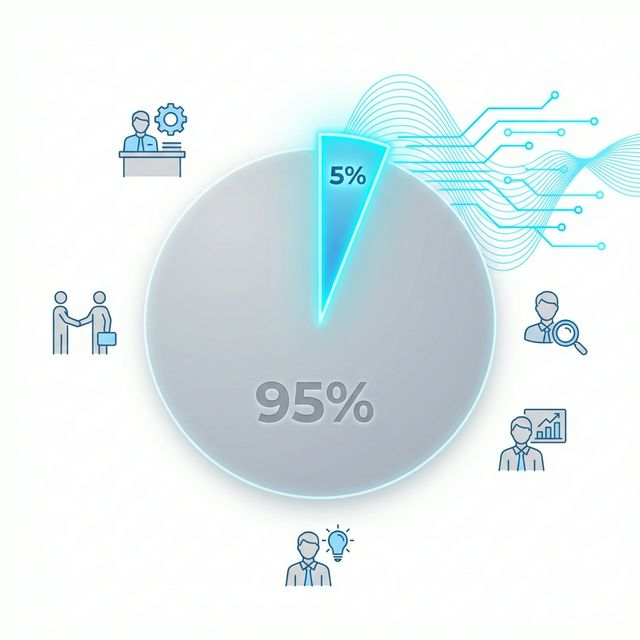
Here is a number that should keep every executive up at night, and every ambitious professional paying close attention:
Boston Consulting Group, 'The Widening AI Value Gap: Build for the Future,' 2025.Only 5% of companies globally qualify as "future-built," meaning they have systematically scaled AI beyond pilots into core operations. These companies generate 1.7x the revenue growth and 1.6x the EBIT margins compared to the rest.
Five percent.
Now here is the uncomfortable flipside: 60% of companies report minimal or no measurable value from their AI investments. They bought the tools. They announced the initiatives. They hired consultants. And most of them are stuck.
Why does this matter to you personally? Because your career trajectory is partly a function of the organization you work inside. If you are at a company in that 5%, you are likely being exposed to AI tools, given training, and positioned to grow with the technology. If you are at a company in the 60%, your skills may be stagnating without you even realizing it.
Think of it like working at a company that refused to adopt the internet in 2005. It was not that the employees were bad at their jobs. It was that the organization's inertia held them back from learning what mattered next.
The gap is widening. BCG found that the leading firms plan to spend twice as much on AI in 2025 compared to laggards. McKinsey's 2025 Global AI Survey echoed this, finding that only about 6% of organizations qualify as high performers generating meaningful bottom-line impact from AI. The pattern is consistent across both studies: a small elite is pulling away, fast.
So what separates the 5% from the 60%?
Before I answer that, here is the part of this story that matters most to you personally: that widening gap is actually your opportunity. The "future-built" companies are growing faster, paying more, and competing fiercely for talent who understand AI. BCG's data shows these firms plan to upskill over 50% of their workforce, but they cannot do it fast enough internally. They need people from the outside who already get it. If you are a career professional who stays at the cutting edge of AI literacy, who understands how these tools work within your domain, you become exactly what the 5% are hunting for. You do not need to work at one of those elite companies right now. You just need to be ready when they come looking. And they are looking. McKinsey's 2025 survey found that the number one barrier to AI value is not technology. It is talent. The companies pulling ahead are talent-constrained, big companies are poaching/stealing talent left and right from each other, trying to hire each others best people they are not technology-constrained. That means an upskilled professional, whether you are in HR, finance, healthcare, or project management, holds genuine leverage in this market. The elite is pulling away from the pack, yes. But the door into that elite is wide open for individuals who have done the work to stay current.
Now, to the question itself. It is not budget. It is not having a fancy AI lab. The "future-built" companies share three characteristics:
- They treat AI as a business strategy, not a technology project.
- They redesign workflows around AI, rather than bolting AI onto existing processes.
- They invest aggressively in training their people and acquiring talent not just their systems.
That third point deserves emphasis. The future-built companies plan to upskill over 50% of their workforce, compared to just 20% for the laggards, so the gap is not just about technology, the technology is here. It's about people.
And that brings us directly to the question on everyone's mind.
Chapter 3: The Job Reshuffling
Let's be straight about this. When it comes to AI and jobs, the predictions are all over the map. And I think you deserve to see that range, not just the optimistic version or the scary version but the range of predictions and sentiments so that you can make up your own mind.
The optimistic forecast:
World Economic Forum, 'Future of Jobs Report,' January 2025. Based on survey data from over 1,000 employers representing 14 million workers across 55 economies.The World Economic Forum's Future of Jobs Report 2025 projects that by 2030, 170 million new jobs will be created while 92 million will be displaced, resulting in a net increase of 78 million jobs worldwide.
That sounds encouraging. And the WEF's data is substantial. But here is where it gets more complicated.
The high-displacement forecasts:
Other models push back hard on the WEF's survey-based methodology. The "Evelin 634" mathematical model predicts that 634 million knowledge-worker positions will face significant displacement by 2034, arguing that surveys underestimate the speed at which AI adoption follows S-curve acceleration. The HAILR model goes further, suggesting that by 2044, 9 out of 10 current knowledge jobs could be displaced as one human, paired with AI, produces the equivalent output of hundreds.
Goldman Sachs lands somewhere in between, estimating that AI could displace 6-7% of the U.S. workforce, but attributing this to a temporary transition, noting that 85% of employment growth since 1940 has come from technology-driven job creation.
So who is right?
As it seems, no one knows for certain. But here is what I take from the range: even the most optimistic scenario involves 92 million jobs being displaced. That is not a small number. And the consensus across every single one of these models is this: the nature of work is changing, the timeline is compressed, and doing nothing is the riskiest strategy of all.
And I can tell you from personal experience of sitting with AI some weeks up to hundreds of hours working with the latest tools, that I do see a reason for concern IF you are not upskilling. To me among thousands of others who work with AI daily, it's very obvious. That's just my personal sense from daily experience of practicing with AI daily.
But here is the part most analysts bury in the footnotes: the data also reveals a very specific type of professional who is not just surviving this transition but thriving in it. It is not who you would guess, and when I got to the skills data, it genuinely surprised me. We will get there.
Who is most at risk?
Brookings Institution and Center for the Governance of AI, January 2026.Approximately 6.1 million U.S. workers face "double jeopardy": high AI exposure and low adaptive capacity (limited savings, limited transferable skills, limited geographic mobility). Of this group, 86% are women, concentrated in administrative and clerical roles.
That is not a statistic to skim past. The vulnerability here is not because of ability. It is because of the types of roles that have historically been held by women (court clerks, secretaries, medical assistants, support agents) and the structural factors that make pivoting harder: lower average savings, fewer transferable credentials, less access to reskilling programs, unless you've found this page.
The fastest-declining roles include data entry clerks, cashiers, bank tellers, and postal service clerks. If these sound familiar, it is because automation has been slowly eating away at them for years. AI accelerates what was already in motion.
But here is the flip side, and it is genuinely exciting:
The fastest-growing roles paint a picture of where the economy is heading:
| Category | Roles | Projected Growth |
|---|---|---|
| Green Energy | Wind turbine service technicians | 60.1% by 2033 |
| Green Energy | Solar photovoltaic installers | 48.0% by 2033 |
| Healthcare | Nurse practitioners | 46.3% by 2033 |
| Technology | AI and Machine Learning Specialists | Surging demand |
| Technology | Data Scientists, FinTech Engineers | Surging demand |
| Human-Centric | Home health aides, vocational teachers | Strong growth |
Sources: U.S. Bureau of Labor Statistics Occupational Outlook (2023-2033 projections); WEF Future of Jobs Report 2025.
Healthcare alone is projected to add roughly 2 million jobs in the U.S. by 2033, driven by aging demographics. Green energy, cybersecurity, and AI-adjacent roles are following close behind. The economy is not shrinking. It is reshuffling.
How this plays out in specific industries:
In healthcare, AI is projected to be an augmentation tool, not a replacement. Despite high integration potential in diagnostics and administrative work, the sector is expected to add the most jobs of any industry by 2033. The reason is simple: aging populations need care, and no algorithm can hold a patient's hand. AI handles the insurance coding, the scheduling, the documentation. Clinicians get to spend more time being clinicians. Actually having human contact and relations. Which I believe is something that will be highly valued in the future.
In legal and finance, the story is more nuanced. Paralegals are projected to grow at just 1.2%, slower than average, because AI can now review thousands of documents in minutes. Financial advisors face competition from "robo-advisors," pushing the profession toward more complex, relationship-driven advisory work. The pattern is the same: routine analysis gets automated, human judgment becomes the premium.
In manufacturing and logistics, humanoid robots are entering the picture. Some models now cost under $6,000. This threatens repetitive manual labor in assembly and warehousing, but it also creates entirely new roles in robot fleet management, maintenance, and human-machine coordination.
The common thread across all sectors? The jobs that involve following a script are shrinking. The jobs that involve writing the script are growing.
And the biggest factor determining which side of the reshuffle you land on? Your ability to adapt. But "adapt" is a vague word. What does it actually look like in practice? It turns out the research points to a very specific shift in how professionals work, a shift that is already underway and that most people have not named yet. It changes what you do with your time, how you interact with your tools, and where your professional value actually sits. Let me show you.
Chapter 4: From Doing to Directing

Let me tell you about the ATM.
When automated teller machines were introduced in the 1970s, everyone assumed bank tellers would disappear. It seemed obvious. Why would you need a person behind a counter when a machine could dispense cash?
But here is what actually happened: the number of bank tellers in the United States increased after ATMs were deployed. Because ATMs made it cheaper to operate bank branches, banks opened more branches. And the tellers? Their job changed. Instead of counting cash all day, they shifted to relationship management, mortgage consultations, and financial advising. The routine task was automated. The human moved upstream.
AI is doing the same thing right now, but across every profession simultaneously and at a pace the ATM could never match. All our work is moving up in level.
The shift happening is this: work is moving from execution to orchestration. AI writes a first draft; you shape the strategy. AI analyzes the data; you interpret what it means. AI generates the code; you architect the system and verify its integrity. AI produces the legal brief; you apply judgment to the case.
This is what the industry is calling "agentic AI," and it is the single biggest paradigm shift in how we work since the personal computer.
What is agentic AI, in plain terms?
Think about the AI tools you might already be familiar with, like ChatGPT or Copilot. You ask them a question, they give you an answer. You are in control and they wait for you.
Agentic AI is different. An AI agent can plan steps, analyze risks, execute tasks, and review its own work with minimal oversight. It does not wait for instructions. It takes initiative. It is the difference between a calculator and an assistant who knows your calendar, your priorities, and your project deadlines.
Korn Ferry, 'Talent Acquisition Trends 2026.'52% of talent leaders plan to add AI agents to their teams in 2026, creating "hybrid" teams of humans and autonomous agents.
This is not science fiction. Companies like Salesforce, Microsoft, and Wrike are already embedding agents into their platforms. Microsoft calls agents "the new Apps." Salesforce has "hard pivoted" to what they call Agentforce. The technology that performed at less than 5% accuracy on software engineering tasks in 2023 now resolves nearly half of those tasks.
The new literacy: directing AI
As AI agents become teammates, a new skill is quietly becoming essential: the ability to direct them effectively. The industry calls this "prompt engineering," but that term is misleading. It sounds technical. In reality, it is closer to being a great communicator, just with a machine instead of a person and understand how you can communicate and what happens when you communicate in different ways.
Four techniques that are proving effective in 2026:
- Context-Aware Decomposition: Breaking a complex problem into clear components while keeping the big picture intact. This is something great project managers already do instinctively.
- Calibrated Confidence: Asking the AI to rate its own certainty before you trust its output. This simple step dramatically reduces "confidently wrong" answers.
- Iterative Refinement: Treating AI output as a first draft, not a final product, and guiding it through rounds of improvement. Exactly the way you would mentor a junior colleague.
- Tool Integration: Understanding how to bootstrap AI tools into a command center AI orchestrator and how to use it to achieve a common goal.
Notice: none of these require coding. They require clarity of thought, communication skills and understanding of how to direct AI, which is a skill every career professional already practices on a human level but MUST learn how to do with AI. MUST!
The pipeline problem no one is talking about
Here is a finding from the research that genuinely is a bit concerning, or lets say serious: when companies automate entry-level roles to cut costs, they destroy their own leadership pipeline. The junior roles being eliminated are where future leaders learn the business, build relationships, and develop judgment. Cut those roles, and you save money today that's good for business now, but you might face a leadership vacuum in five years.
Korn Ferry, 'Talent Acquisition Trends 2026.'Only 22% of company leaders are considered ready to manage mixed human-AI teams.
That means even the leaders don't know what they are doing with AI. Which gives you and I a major advantage if we do. People look to those who know?
It's an opportunity for anyone willing to develop hybrid management skills before everyone else catches up. And what those skills actually are, according to the people doing the hiring at the world's largest companies is this.
First you have to understand that the skillset that got you here will not be the skillset that takes you forward. If your value proposition at work is "I can process things quickly and accurately, or I know a lot or I have a lot of domain expertise" well AI will eventually do that faster and know more, more precisely. But if your value proposition is "I can make sense of complex situations, manage relationships, make judgment calls, and my experience into intelligent tools toward the right outcomes," you become more valuable, not less.
And knowing how to direct the tools, is a big thing here.
You do not need to know how an engine works to drive a car. But you absolutely need to know how to drive the car. AI literacy is learning to drive. And the road is already open and the car is already great.
Chapter 5: The Skills That Actually Matter
Here is something that surprised me when I dug into the research, and I think it will surprise you too:
Korn Ferry, 'Talent Acquisition Trends 2026.'73% of talent acquisition leaders rank critical thinking and problem-solving as the most needed skill for 2026. In other words Agency. AI technical skills ranked fifth.
Read that again. The people whose literal job it is to hire talent for the world's largest companies are not primarily looking for people who can code AI. They are looking for people who can think.
Why? Because the bottleneck is no longer "Can we generate output?" AI can generate output all day long and you no longer need to be a technical expert to use it - everyone can use it, it has never been easier for anyone, even someone with 0 experience to go from 0 to a hundred with advanced technology. The bottleneck is "Can someone figure out how to get the output and then verify whether this output is correct, relevant, and strategically useful?" That requires judgment. That requires critical thinking, it requires a bit of creativity and it requires Agency. And combined with domain expertise: the kind of deep knowledge you build over a career in nursing, in law, in project management, in education, in any field a person who has this quality of being able to solve problems with the tools and who can take initiative is exactly what the world is looking for.
The AI Literacy Framework
In February 2026, the U.S. Department of Labor released a formal AI Literacy Framework (Training and Employment Notice 07-25) designed to set the standard for what every worker needs to know. It is built around five foundational areas:
- Understand AI Principles - Know what AI can and cannot do. Understand that it produces probabilistic outputs, not facts. Recognize that it reflects the choices of the humans who built it.
- Explore AI Uses - Identify how AI applies in your specific professional context. This is different for a nurse than for a marketer than for an engineer.
- Direct AI Effectively - Learn how to communicate with AI tools. Prompt engineering is not just for developers. It is the new standard professional communication skill. It's the basis of everything.
- Evaluate AI Outputs - Verify facts. Spot logic gaps. Catch hallucinations. This is where your domain expertise becomes your superpower.
- Use AI Responsibly - Protect privacy. Follow policies. Understand the ethical implications of AI-assisted decisions.
Source: U.S. Department of Labor, TEN 07-25, released February 13, 2026.
- Adapt and Evolve - Which includes, getting a high proficiency in using AI tools. Understand that AI is constantly changing. Be prepared to learn new tools and techniques. Be prepared to adapt to new ways of working. Be prepared to change the way you think about your job. Be prepared to change the way you think about the world. Be prepared to change the way you think about yourself.
The skills instability problem
World Economic Forum, 'Future of Jobs Report,' 2025.44% of workers' core skills are expected to change by 2030. 85% of employers plan to prioritize upskilling to address this gap.
The shift is not just about learning new tools per se. It is about how you learn. The traditional model - go to university, learn a skill, use it for 30 years - is already obsolete. The new model looks more like continuous micro-credentialing: short, targeted programs that keep your skills current.
Universities and professional bodies are already responding. Johns Hopkins has launched an AI in Healthcare certification. Cornell offers AI strategy programs. ISACA created an AI Security Management credential. The market for targeted, practical training is exploding because employers cannot wait for four-year degree cycles to close the gap.
The OECD perspective
The OECD and TeachAI have published a complementary framework that approaches AI literacy through four practical domains:
- Engaging - Using AI for information while evaluating its bias and accuracy.
- Creating - Co-creating content with AI while managing intellectual property risks.
- Managing - Delegating tasks to AI and overseeing its function.
- Designing - Understanding data and algorithms well enough to shape AI systems for social good.
What I find powerful about these frameworks, is that they do not assume you need to become a technologist. They assume you need to become a thoughtful user. There is a big difference.
My recommendation: Do not try to become a data scientist (unless that genuinely excites you). Instead, become the person in your field who understands AI well enough to use it wisely and effectively. The nurse who can evaluate AI-generated diagnostics. The lawyer who can audit automated contract review. The project manager who can orchestrate hybrid teams of humans and agents. That is where the premium sits. But you gotta put in the time of learning not just the tools but understanding the workflow frameworks that will be used across all tools.
And if you are wondering where to point these skills, there are entire sectors experiencing explosive, under-the-radar growth that most career professionals are not even watching. The numbers in some of these sectors are genuinely surprising.
Chapter 6: The Quiet Boom Sectors

While headlines focus on AI displacing jobs, there are entire sectors experiencing explosive growth that rarely get the attention it deserves. If you are thinking about your next career move, or advising someone who is, these numbers are worth studying.
Healthcare: The Unstoppable Wave
Healthcare is projected to be the fastest-growing sector through 2034, with roughly 8.4% growth and approximately 2 million new jobs in the U.S. alone. This is not driven by AI. It is driven by demographics: populations are aging worldwide, and no amount of technology eliminates the need for human care.
What AI does in healthcare is augment, not replace. It handles administrative burden (scheduling, documentation, insurance coding) so that clinicians can spend more time with patients. Nurse practitioners are projected to see 46.3% growth by 2033. Home health aides are surging. These are deeply human roles that become more valuable as AI takes care of the paperwork or the precisions of diagnostics, diagnosis and surgery.
Green Energy: The Infrastructure of Tomorrow
Remember how I said AI infrastructure is the new electricity? Well, that infrastructure needs actual electricity. And the green energy transition is creating its own job boom. Aside from all the Data centers that needs electrical engineering, there is also the need for more sustainable energy sources.
Wind turbine service technicians and solar photovoltaic installers are the two fastest-growing occupations in the entire U.S. economy. Tech giants are turning to nuclear power to keep up: Amazon purchased a nuclear-powered data center, and Microsoft signed a deal to restart the Three Mile Island nuclear plant.
This creates a secondary job market that most career professionals overlook: energy infrastructure, sustainability management, grid engineering, and the policy roles that regulate all of it.
Quantum Computing: The Talent War No One Sees Coming
This one is further out, but it matters if you are planning a 5-10 year career horizon. Job postings requiring quantum computing skills tripled between 2011 and 2024. Most scenarios for 2030 suggest we are in early stages, but if scalable quantum computing arrives sooner than expected, the demand for quantum-ready professionals will spike faster than any training pipeline can fill. That means if you have any expertise in that domain, you hold leverage, if you are in law, finance, medicine, or any other domain that is impacted by quantum computing or can take part in it, you might want to start learning about it is about now.
The Longevity Economy
AARP Longevity Economy studies; U.S. Department of Labor data.The 50-plus population contributed $45 trillion to global GDP in 2020, projected to rise to $118 trillion by 2050. Supporting working caregivers age 50+ could add $1.7 trillion to U.S. GDP by 2030.
The traditional "learn, work, retire" model is being replaced by multistage careers involving reskilling, care breaks, and phased retirement. For career professionals in mid-to-late career, this is not a threat. It is an opportunity. You have decades of domain expertise. The economy increasingly needs it. The question is whether you stay current enough to leverage it.
If you have experience but you do not embrace AI fully, you are shooting yourself in the foot, if you have no experience and you don't embrace AI, you are shooting yourself in the foot - but if you do have experience and you embrace AI you have an advantage, and if you have no experience but embrace AI you can catch up.
There is also a hidden crisis here that affects professionals across all age groups: unpaid family caregiving, valued at approximately $470 billion annually in the U.S., is quietly pulling millions of workers out of the labor force or into part-time arrangements. Employers who implement caregiver support policies (flexible work, paid leave, phased return) are not just being generous. They are tapping into a massive pool of experienced talent that would otherwise be sidelined.
The Geopolitical Backdrop
All of these workforce and technology trends are playing out against a backdrop that most career guides ignore but that directly affects your professional life.
Authoritarian powers are challenging international norms, particularly around the free flow of information and technology. Water insecurity is threatening economic growth in developing nations, with some regions facing GDP losses of up to 6% by 2050. Public skepticism of institutions is surging, fewer people trust the government and official media than ever before, - some would say for good reason - driving demand for corporate accountability and transparency.
Why does this matter for your career? Because the companies you work for, the markets you serve, and the supply chains you depend on are all operating in this environment. Geopolitical literacy is, increasingly, a professional skill. Understanding that AI development is happening within a context of competing national interests, sovereign data strategies, and resource constraints helps you make better decisions about where to invest your career energy.
But navigating opportunity is only half the picture. There is a new rulebook being written around AI right now, and the professionals who understand it early will have an edge that most of their peers will not even realize exists until it is too late.
Chapter 7: The Rules Everyone Needs to Know

I am going to be straightforward: the regulatory landscape around AI is messy. It is a patchwork of federal ambitions, state-level enforcement, and international compliance frameworks that often contradict each other, they haven't really figured out the soup yet. But as a career professional, you need to know the basics because they directly affect your work.
The U.S. Picture
A new Executive Order (December 2025) titled "Ensuring a National Policy Framework for Artificial Intelligence" signals the federal government wants to consolidate AI oversight. But states are not waiting. The Colorado AI Act takes effect in June 2026, imposing a duty of care on anyone who develops or deploys high-risk AI to prevent algorithmic discrimination. California and New York have strict rules on AI in hiring and require "kill switches" for large-scale frontier AI systems.
If your company uses AI for hiring, lending, customer service, or any decision that affects someone's livelihood, compliance is not optional, however they are still being defined and the rules are different depending on where you operate.
The EU AI Act
Fully phased in since August 2025, the EU's framework classifies AI systems by risk level. High-risk applications (employment, finance, education) face strict data quality and human oversight requirements. If your company does business in Europe, or serves European customers, this matters.
But aside from this, knowing that policy is being written, those of you who work in the domain of law, policy or politics can use this as a springboard to be early and strong in something that is only just emerging but will be around for a long time.
Sovereign AI: Borders in the Cloud
Here is a concept that most career professionals have never heard of but will increasingly encounter, remember this, in a few years it everyone will know what it means: sovereign AI. It means keeping data, models, and computing power within national or organizational borders. Think of it as data nationalism applied to artificial intelligence.
Accenture Technology Vision, 2025.83% of companies now view sovereign AI as important to their strategic planning.
Nations are racing to build domestic AI infrastructure so they do not depend on foreign technology stacks. Japan, Canada, France, and others have announced massive sovereign cloud projects. For career professionals, this means the AI tools available to you may increasingly depend on where you work geographically. It also creates roles in compliance, data governance, and cross-border technology strategy that barely existed two years ago. It's a brand new phenomena at this scale.
Shadow AI: The Invisible Risk
BCG, 'The Widening AI Value Gap,' 2025; Accenture Technology Vision, 2025.72% of companies report unmanaged AI security risks. Employees are increasingly using AI tools without employer knowledge, creating security and intellectual property exposure.
This is the governance issue that almost no one is prepared for. When someone on your team pastes proprietary data into a free AI chatbot, they may be creating a compliance violation, a data breach, or both. Understanding this is not just a leadership responsibility. It is everyone's responsibility and it will be someones livelihood to guide and lead in that domain in the near future.
The Copyright Reckoning
Cases like New York Times v. OpenAI are testing whether training AI on copyrighted material constitutes fair use. The outcome will reshape how AI-generated content is treated across industries, from journalism to education to legal services. If you create content professionally, this might be something you want to keep an eye on.
Agentic Liability: Who Is Responsible When AI Acts?
As AI agents start executing contracts, making purchasing decisions, and handling customer interactions autonomously, a new legal question is emerging: when an agent makes a mistake, who is liable? The user who deployed it? The company that built it? The agent itself? Courts are beginning to weigh in, and the answers will shape how every organization deploys AI in customer-facing and decision-making roles and this also a brand new phenomena at this scale.
Why this matters to you: Knowing the rules is becoming a career skill. Companies need people who can navigate AI governance, ensure compliance, and bridge the gap between what the technology can do and what the law allows. If you understand both the tools and the rules, you occupy an increasingly rare and valuable position.
I would say anyone who works in legal in some capacity or touches it in any way, shape or form needs to pay very close attention to this. This is going to be a massive part of the future of law and policy.
Now, I have spent seven chapters showing you part of the landscape far and wide: what is being built, how the job market is reshuffling, what skills might matter, where the growth is, and what rules are forming around all of it. It is time to put it together. Everything I have shown you converges on a very specific set of moves you can make right now, tailored to where you are in your career. This is where the open threads come together.
Chapter 8: Your Move

I have spent seven chapters giving you some broad context. Now let me give you a plan.
The transition gap between AI-driven displacement and new job creation is projected to be most acute between 2027 and 2031. That gives you a window. of a year or two at most Not long years, because it's coming fast, but it's just enough to make deliberate moves. Here is how I would think about it, based on everything the research tells us and my own personal experience on sitting with the tools deep in the trenches daily - for what it's worth.
If you are early in your career:
Do not let your entry-level role get automated out from under you without building what comes next. Seek orchestration responsibilities as fast as possible. Volunteer to manage AI tools on your team. Spend all extra time you have on learning how to use Orchestration tools, become the person who bridges the gap between what AI produces and what the organization needs. Build domain expertise that AI cannot replicate or becomes very valuable with specific experience behind it. Every year of deep context you accumulate makes you harder to replace.
And push back, respectfully, if your organization is eliminating junior roles without creating alternative learning paths. The leaders of 2035 are being shaped right now by the experiences they get in 2026.
If you are mid-career:
You are, in many ways, the most valuable person in this transition. You have something AI fundamentally lacks: years of contextual judgment in a specific domain. You know what good looks like. You know where the edge cases are. You have the relationships, the instincts, and the scar tissue that no training dataset can replicate. If you do not augment your experience with AI, you are squandering your experience in the most transformational period of human history.
Your move: pair that expertise with AI fluency. You do not need to become technical. You need to become capable. Learn to direct AI tools within your domain. Evaluate their outputs with the critical eye that only experience provides. The combination of deep domain knowledge plus AI literacy is the most valuable professional profile in the 2026 economy and onwards.
Now the only challenge hurdle, the frog you need to swallow, is embracing the tooling, but it's much easier than you think, and furthermore, you're lucky, you are here with me. :D
Also consider this: the longevity economy means your career is likely longer than previous generations assumed. The "learn, work, retire" arc is being replaced by cycles of learning, working, pivoting, and contributing across decades. Your mid-career is not the middle. It might be the beginning of act two.
If you are in leadership:
Your job is to build the hybrid team. That means managing handoffs between humans and machines. It means communicating authentically about AI-driven changes so your people do not panic or resist. It means protecting the junior roles that feed your future talent pipeline while still realizing AI's productivity gains.
It also means auditing your organization for shadow AI, mapping which tools your teams are already using without oversight, and building governance before regulators force you to. The companies that proactively govern AI use will have a significant competitive advantage over those that scramble after the first compliance failure.
Regardless of your career stage, here are five actions to take this year:
- Start using AI tools in your actual work. Not just reading about them and not just consumer tools and basic chatbots, but the actual orchestration tools that can be used in your industry. Pick one task you do every week and try doing it with an AI assistant. See where it helps. See where it fails. That is experiential learning. However my mission is to make that part as easy as possible for any professional by pointing you in the direction where it matters. I sit with the tools every hour of the day and I can tell you which to use and how to use them to set yourself up for the future. So you are not alone in dark.
- Pursue one targeted micro-credential. Not a four-year degree. A certification that connects AI to your field: AI in healthcare, AI security management, AI for project professionals. Organizations like Johns Hopkins, Cornell, ISACA, and many industry bodies offer programs that take weeks, not years and at the very basic, Coursera offers Certificates from organizations like google. Google also have their own very new Learning platform called that centers on AI called GEAR - search google GEAR cloud to find out more.
- Audit your own "adaptive capacity." Be honest with yourself. Do you have transferable skills? Financial reserves for a transition? Geographic flexibility? If not, start building those buffers. The Brookings data on the 6.1 million vulnerable workers is a warning, not a prophecy, start loving the 'Pivot' don't be stuck in 'expertise' be willing to acquire new domain experience.
- Learn to evaluate, not just generate. The most important skill is not "make AI produce stuff." It is "verify whether what AI produces is accurate, ethical, and useful." Shift your learning focus accordingly.
- Watch the regulations. Especially if you are in HR, finance, legal, healthcare, or any field where AI-assisted decisions affect people's lives. Compliance literacy is becoming as important as technical literacy. The Colorado AI Act, the EU AI Act, and NYC's hiring rules are just the beginning.
Conclusion: The Window
Here is where I leave you.
The research is clear on the trajectory: AI is not a trend that peaks and fades. It is infrastructure, like electricity, like the internet, that permanently changes the operating environment for every profession - and human kind as a whole. The $660-690 billion being spent in 2026 alone is not speculative. It is committed capital with concrete timelines.
But the research is also clear on something else: this is not a story about humans being replaced. It is a story about humans being reorganized. The administrative task that took you two hours becomes a 10-minute review. The analysis that required a team of analysts becomes something you can do with one person and an AI agent. The applications that required a team of experts can now be build by a novice with little experience. The routine disappears. The judgment, the creativity, the relationships, the strategic thinking? Those become more valuable than ever.
I want to leave you with one more statistic. Forrester predicts that enterprises will defer 25% of planned AI spending to 2027 as CFOs demand clearer returns on investment. That might sound like AI is slowing down. It is not. It means the hype is being replaced by accountability. Companies that spent recklessly are now being asked to show results. The ones that invested wisely are pulling ahead. And in that shift from hype to results, the professionals who can bridge the gap between AI's potential and measurable outcomes become the most important people in the room.
Despite all the uncertainty around tariffs and geopolitics, global technology spending is still projected to grow 7.8% in 2026, reaching $5.6 trillion. The investment is not stopping. It is maturing. And mature investment rewards people who understand what they are doing, not just people who jumped on a trend.
The transition window is real. The data suggests 2027-2031 will be the sharpest period of adjustment. If you position yourself before that window, you are ahead of the curve. If you wait until your company rolls out mandatory training or, worse, until your role changes underneath you, you are reacting instead of responding. Take the lead now.
I wrote this book because I believe career professionals deserve better than hype or fear. You deserve clarity. The kind that lets you make decisions from a position of understanding, not anxiety BUT the downsides are real, it's not fugazi but so is the upside.
The shift is happening. Your career, your skills, your future - they are not being written for you. You get to write them yourself and there has never been a time in history where you can assume power and authority, in such an accessible way, without a middleman, if you are willing to apply personal initiative and couple your thinking and experience with technology.
But you have to pick up the pen and start writing your future.
The AI Shift was synthesized from four comprehensive research briefings spanning Fortune 500 corporate strategy, global workforce displacement data, upskilling industry analysis, and AI regulatory/literacy frameworks. Primary sources include the World Economic Forum Future of Jobs Report 2025, Boston Consulting Group AI Value Gap Study 2025, Brookings Institution/Center for the Governance of AI 2026 report, Korn Ferry Talent Acquisition Trends 2026, U.S. Department of Labor AI Literacy Framework (TEN 07-25), McKinsey Global Institute, U.S. Bureau of Labor Statistics, OECD/TeachAI, AARP, Accenture Technology Vision 2025, Forrester, and corporate earnings data from Alphabet, Microsoft, NVIDIA, and JPMorgan Chase.
Go Deeper
Each episode explores the research behind this book in a conversational, podcast-style format. Listen while you work, commute, or think about your next move.
The 2026 Shift: From Chatbots to Agents
How Fortune 500 companies are moving beyond simple chat interfaces to deploy autonomous AI agents that plan, execute, and review their own work.
The AI Job Market Survival Guide
A deep dive into the displacement data, who is most vulnerable, and the specific career moves that the research says actually work.
Your 2026 Career Survival Guide
The sectors with explosive growth, the micro-credentials employers actually value, and how to position yourself before the transition window closes.
Orchestrating AI Agents Like On-Demand Interns
Practical frameworks for directing AI tools effectively, from prompt techniques to hybrid team management.